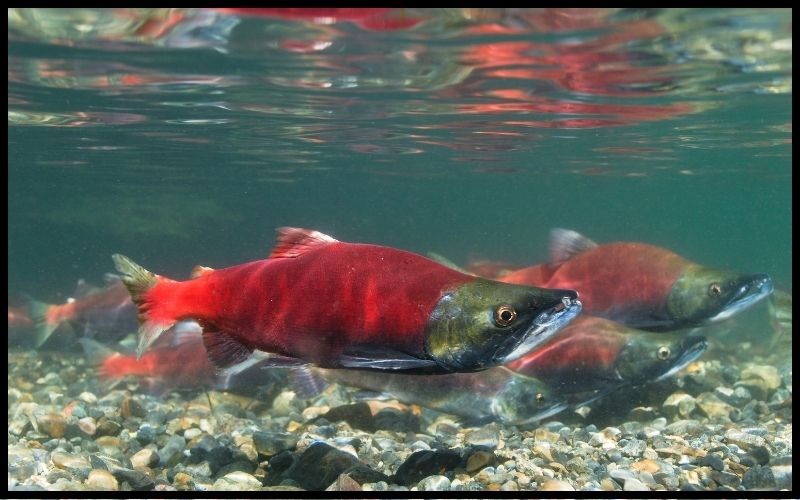
How can we restore form and function to rivers, streams, and wetlands that support Pacific Salmon? This course provides the intellectual tools to tackle assessment monitoring and restoration design of Pacific salmonid habitat.
Some of the basic topics and questions covered include:
- History of salmonid habitat restoration – How long have salmon issues been issues? How have we responded? What’s been working and what hasn’t?
- Ecohydraulics – How does stream flow affect salmonid ecology and habitat forming processes? What basic ecohydraulic processes do we need to account for? What tools should we use? How can we use ecohydraulics to understand why a site is functional versus non-functional?
- Ecohydraulic design – the basic act of designing channel and floodplain features to meet specific target depths and velocities. How do we take basic habitat information and design functional ecosystems?
- Sediment transport – sediment is a vital aspect of rivers and streams and a key variable known to affect spawning. How does sediment move in rivers? How can we measure and model it? What tools are available?
- Forcing Elements – what role does wood and coarse sediment play in salmon rivers and streams? How can we integrate Forcing elements into our design and management plans?
- Monitoring – How do we measure project success?
- Modern river restoration techniques – What tools do we have to restore salmonid habitat form and function?
- Fish passage – How do we assess and correct fish passage limiting factors?
What attendees are saying about the course: "I learned a ton ... [The instructors] are very knowledgeable and helpful when answering questions." Meredith G., May 2019 "I really enjoyed the field component of the class. It incorporated the concepts we learned to a real-life situation." Shena H., November 2015 "Both Joe and Rocko were very engaging and knowledgeable. I really appreciated how enthusiastic and easy-to-listen-to they were." Mandy C., November 2015 "I liked the variety of material covered; how we had both the biology as well as the geomorphology." Paige A., Feb 2013 |
This course is designed for practitioners and agency personnel involved with field data collection, detailed design and/or review of river restoration projects. It provides general training in design, implementation and monitoring of in-stream habitat improvement projects in regulated streams and rivers, with an emphasis on the issues surrounding Pacific salmonid spawning.
Suggested - "The Ecology of Pacific Salmonids"
The course will explain and demonstrate common techniques for:
- Assessing habitat and collecting and analyzing field data
- Integrating physical, biological and aesthetic objectives into habitat improvement design
- Characterizing and estimating sediment transport and sediment budgets for enhancement sites
- Designing effective monitoring programs
- Choosing appropriate fish habitat improvement designs
- Channel and instream structure design
- Sediment transport
- Understanding enhancement limitations
- Selecting equipment and material
- Fish passage assessment and design techniques
- Data and project presentation